
The lack of data accuracy and completeness in the construction industry is leading to unreliable embodied carbon reporting for as-built assets which is a key requirement for BREEAM V7. This includes data for materials received, waste leaving site and energy consumed during live projects.
Significant number of material delivery notes and waste transfer notes have either data missing or simply of poor quality hampering embodied carbon calculations.
Poor data quality in construction is a systemic issue costing the industry billions globally often driven by manual processes, communication challenges and low adoption of technology solutions. This is causing significant inefficiencies, safety risks, and severely hampers sustainability goals and reliably reporting carbon emissions.
Impacts of Poor Data
- Safety & Compliance Risks – Inaccurate, missing, or fragmented information increases safety hazards and breaches in compliance (Building Safety Act 2022)
- High Financial Cost – Inaccurate data causes substantial financial losses and delays.
- Sustainability Failure – Without accurate data, tracking embodied carbon is difficult leading to unreliable sustainability targets.
- Operational Inefficiencies – Inconsistent reporting and manual data entry errors cause significant delays and escalating costs squeezing profitability
Poor Data Root Causes
- Fragmented Information – Lack of a single source of truth often results in siloed information. Hidden data and complexity prevents informed decision making.
- Human Error – Extensive manual data handling leading to erroneous data potentially requiring rework and delays.
- Low Digital Maturity – Slow adoption of digital tools and poor integration of systems often due to lack of IT maturity.
The Way Forward
- Implementing Data Governance – Establishing clear policies for data collection and management.
- Adopting Digital Solutions – Transitioning from manual processing of data to automated digital systems
- Data Audits and Monitoring – Regularly auditing project data to ensure accuracy and completeness to meet business objectives
Gain visibility of all your site data and emissions
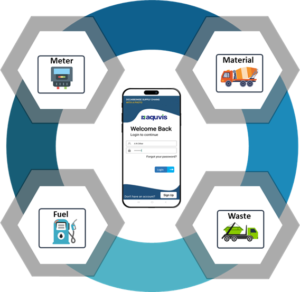
The Aquvis platform automates the process of collecting, analysing and calculating site carbon emissions during the construction phase in real-time. The application provides detailed insights and dashboards for contractors and developers. Conduct detailed analysis across portfolio of building projects and compare materials to optimise decarbonisation and make informed material choices during projects. API’s enable integration with external systems. Integrate aquvis carbon data with internal and external analysis tools such as Power BI. A single solution powered by a robust, scalable and secure SaaS platform for project, sustainability and procurement teams.
Key challenges in Material Delivery Notes
Our findings to date have highlighted the below key issues with material deliveries:
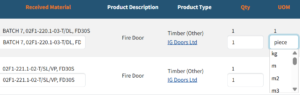
- Description of materials cannot easily be interpreted either by individuals or systems e.g. FD60S 02F1-426.3-01-T/S
- The unit of measure is often presented as palette, bulk bags, piece, length, roll, sheet, pack, box and each. These need to be converted to suitable units for emissions calculations such as Kg or m3 (weight, volume)
- Deliveries do not always include the site address or supplier dispatch details.
The aquvis solution easily overcomes these issues to ensure that each material delivery is accurately recorded and carbon calculations are automatically calculated using manufacturers EPD’s. With Human in the Loop (HITL) capabilities you can easily update all of these details for each line item in the delivery note. Our AI and machine learning means that you need to only fix this once i.e. first time. Next time any material with descriptions and units of measure (UOM) that have been amended are automatically assigned to the updated data.
Key challenges in Waste Transfer Notes
Often the following details are missing from WTNs:
- European Waste Catalogue (EWC) codes
- Standard Industry Code (SIC) for the waste producers
- Quantity and description of the waste
- Container size
- Date of when the waste was transferred
- Site address from where waste is being collected and waste destinations
- Waste carrier licenses and waste operator permits and exemptions certificate details.
Aquvis enables you to comprehensively capture and complete these details ensuring that you are fully compliant with your waste duty of care obligations.
Improving data quality is critical for informed decision making and meeting your regulatory and compliance needs. It is now a cornerstone of ensuring future success to achieving sustainability targets and profitability.